
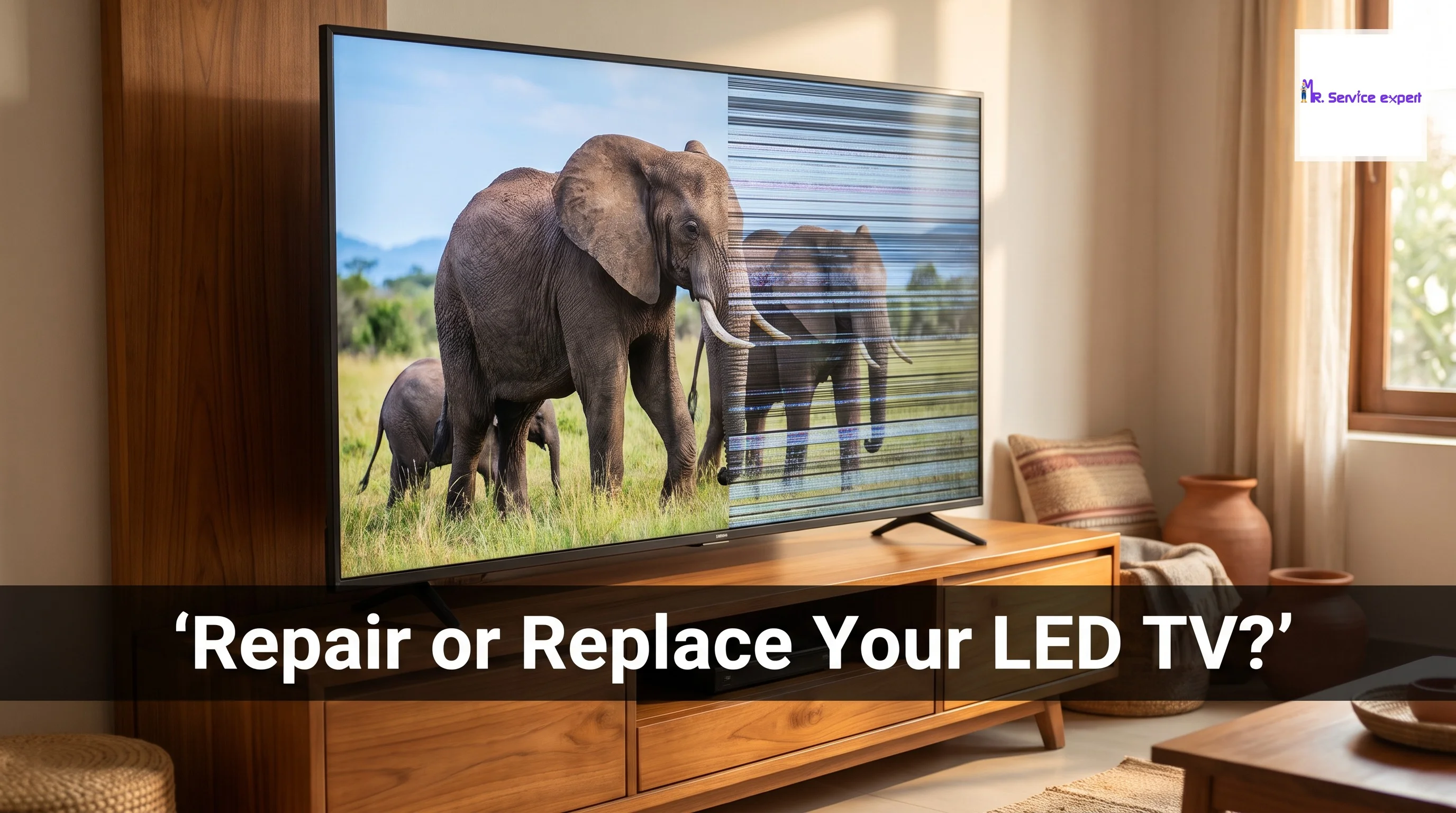
Signs Your LED TV Needs Repair vs Replacement
Your LED TV suddenly starts showing strange lines across the screen, or perhaps it refuses to turn on altogether. That sinking feeling hits you as you wonder whether this means an expensive repair bill or the need to buy a completely new television. Understanding the LED TV replacement signs and knowing when LED TV repair vs replace decisions make financial sense can save you thousands of rupees and prevent unnecessary purchases. This comprehensive guide walks you through every indicator that signals whether your television needs professional attention or deserves retirement.
Modern LED televisions have become central to Indian households, serving as entertainment hubs for families across metros and smaller cities alike. With prices ranging from fifteen thousand rupees for basic models to several lakhs for premium options, these investments deserve careful consideration when problems arise. Many homeowners rush into replacement decisions without properly assessing repair possibilities, while others throw good money after bad trying to fix televisions beyond redemption. The key lies in recognizing specific warning signs and understanding cost-benefit calculations.
Television technology evolves rapidly, with new features emerging every year that make older models seem outdated. However, technological advancement alone rarely justifies replacement if your current TV functions properly. Problems ranging from minor software glitches to major hardware failures each demand different approaches. Some issues resolve with simple troubleshooting steps, others require professional LED TV repair experts, and certain conditions indicate the time has come for replacement.
Indian consumers face unique considerations in this decision-making process. Limited warranty coverage after purchase, varying service quality across regions, and the significant price difference between repair and replacement all factor into the equation. Additionally, environmental consciousness increasingly influences choices, as responsible disposal and recycling become more important. Making informed decisions requires understanding both technical aspects and practical realities of television ownership.
This article examines critical LED TV replacement signs, compares repair versus replacement scenarios, and provides actionable guidance for homeowners facing television troubles. Whether you notice picture quality degradation, sound issues, power problems, or complete failure, you will learn exactly what each symptom indicates and the best course of action for your specific situation.
Understanding Common LED TV Problems
LED televisions experience various problems throughout their lifespan, ranging from minor annoyances to catastrophic failures. Screen-related issues represent the most common category of complaints. Dead pixels appear as tiny black dots that do not display color, while stuck pixels show constant single colors. A few isolated dead pixels typically do not warrant concern, but clusters spreading across the screen suggest deeper panel problems. Vertical or horizontal lines indicate driver board failures or panel damage, conditions that significantly impact viewing experience.
Backlight problems manifest differently than pixel issues. If your television displays faint images visible only in darkened rooms, backlight failure likely occurred. LED backlights consist of multiple strips behind the screen, and when these fail, entire sections appear darker. Complete backlight failure leaves the screen black despite the television receiving power and processing signals. These issues often stem from LED strip degradation, power supply problems, or driver board malfunctions.
Sound-related problems include complete audio loss, crackling noises, volume inconsistencies, or audio-video synchronization issues. While some sound problems originate from external speaker connections or settings, internal speaker failures or audio board malfunctions require technical intervention. Distorted sound that persists across all input sources points toward internal component issues rather than source device problems.
Power and connectivity issues also plague LED televisions. Random shutdowns, failure to turn on, continuous restart loops, or power LED blinking patterns each indicate specific problems. HDMI port failures prevent signal recognition from connected devices, while USB ports may stop reading external drives. Smart TV features might malfunction, with applications crashing, WiFi connectivity dropping, or entire operating systems freezing.
Physical damage from impacts, liquid spills, or electrical surges creates obvious repair-versus-replace scenarios. Cracked screens almost always necessitate replacement due to prohibitive repair costs. However, damaged ports, broken stands, or cosmetic cracks in the housing often allow economical repairs. Understanding which problems stem from repairable components versus integral panel damage helps homeowners make appropriate decisions.
Critical LED TV Replacement Signs
Certain symptoms definitively indicate replacement makes more sense than repair. Screen cracks or shatters represent the clearest replacement signal. LED panel replacement typically costs seventy to eighty percent of new television prices, making repair financially illogical. Even minor cracks spread over time, and cracked screens pose safety risks from sharp edges and potential electrical exposure. If accidental damage coverage does not apply, purchasing new equipment proves more economical.
Widespread screen burn-in or image retention indicates permanent panel damage. While temporary image retention might clear after displaying varied content, true burn-in permanently ghosts static images onto the screen. This condition develops when identical images display for extended periods, common with news tickers, game interfaces, or channel logos. Burn-in cannot be repaired; it reflects permanent phosphor degradation requiring complete panel replacement.
Multiple simultaneous failures suggest your television reached end-of-life. When sound issues combine with picture problems, power irregularities, and connectivity failures, the cumulative repair cost often exceeds replacement value. Component failures rarely occur in isolation as televisions age; cascading problems indicate systemic degradation. Attempting piecemeal repairs in such situations leads to recurring service calls and mounting expenses.
Age significantly influences repair-versus-replace decisions. LED televisions typically last seven to ten years with average usage. Models exceeding eight years old face limited parts availability, as manufacturers discontinue support for older products. Even if repairs seem feasible, finding compatible components becomes challenging. Additionally, technological improvements over eight years make modern televisions substantially superior in picture quality, energy efficiency, and features.
Repair estimates exceeding fifty percent of current replacement cost rarely make financial sense. This threshold accounts for repair labor, parts, and the reality that repaired components may fail again relatively soon. If a LED TV technician quotes fifteen thousand rupees for repairs on a television replaceable for thirty thousand rupees, replacement offers better long-term value. However, premium televisions warrant higher repair thresholds, as replacing a high-end model costs significantly more.
Energy efficiency degradation represents a subtle replacement sign. Older LED televisions consume considerably more power than current models. If your electricity bills seem disproportionate to usage, an inefficient television might be responsible. Modern LED TVs consume thirty to fifty percent less power than models from five years ago. Calculate annual energy costs; significant consumption might justify upgrading to energy-efficient models that pay for themselves through reduced electricity bills.
When LED TV Repair Makes Sense
Many television problems prove easily repairable at reasonable costs. Power supply board failures rank among the most common repairable issues. Symptoms include complete power loss, clicking sounds, or LED indicators blinking specific patterns. Power board replacement typically costs between three thousand and eight thousand rupees depending on television size and brand. This repair extends television life significantly and costs far less than replacement.
Backlight repair offers another cost-effective solution for specific problems. When some backlight strips fail while others function, targeted LED strip replacement costs five thousand to twelve thousand rupees. This repair restores full brightness and proves worthwhile for televisions under five years old. However, complete backlight system failure on older models often signals broader issues, tilting decisions toward replacement.
Main board or T-con board replacements address various operational problems. The main board processes inputs, controls picture settings, and manages smart features. T-con boards control panel timing and image rendering. These component replacements range from four thousand to fifteen thousand rupees. For televisions worth forty thousand rupees or more, such repairs clearly make financial sense, especially when other components function properly.
HDMI port repairs or replacements solve connectivity issues without replacing entire televisions. Damaged ports from frequent cable insertion, electrical surges, or manufacturing defects prevent signal recognition. Individual port replacement costs two thousand to five thousand rupees, while adding new ports might cost slightly more. This repair extends television usability significantly, particularly for models with limited connectivity options.
Software and firmware issues often resolve without hardware replacement. Smart televisions occasionally experience operating system crashes, application failures, or performance degradation. Factory resets, firmware updates, or software reinstallation performed by qualified LED TV service professionals typically costs minimal amounts, sometimes only service call fees. These solutions restore functionality completely when hardware remains intact.
Speaker replacements address audio failures economically. Internal speaker damage from power surges or age-related degradation affects sound quality without impacting picture performance. Speaker replacement costs three thousand to seven thousand rupees depending on television model. This repair makes sense for otherwise functional televisions, especially larger screens where replacement costs run high.
Cost Analysis: Repair vs Replacement Decision Framework
Making informed LED TV repair vs replace decisions requires systematic cost-benefit analysis. Begin by obtaining accurate repair estimates from qualified LED TV repair experts. Request detailed breakdowns identifying specific failed components, parts costs, labor charges, and warranty terms on completed work. Compare estimates from multiple service providers, as rates vary significantly across regions and technicians.
Calculate your television's current market value. Research online marketplaces, electronics retailers, and manufacturer websites to determine replacement costs for equivalent models. Consider your existing television's size, resolution, smart features, and brand reputation when identifying comparable replacements. Factor in that new models typically include improved technology, longer warranties, and energy efficiency benefits.
Apply the fifty-percent rule as a baseline guideline. If repair costs exceed half your television's current replacement value, replacement generally makes better financial sense. However, adjust this threshold based on specific circumstances. Premium televisions warrant higher repair percentages, perhaps sixty to seventy percent, while budget models justify lower thresholds around forty percent.
Consider remaining useful life after repair. A five-year-old television repaired today might provide another three to five years of service, potentially justifying higher repair costs. Conversely, eight-year-old models nearing typical lifespan limits may fail again shortly after repairs, wasting investment. Evaluate repair longevity realistically rather than assuming indefinite continued operation.
Account for opportunity costs and feature upgrades. Modern LED televisions offer 4K resolution, HDR support, superior smart platforms, voice control, and enhanced connectivity that older models lack. If your current television operates at 1080p resolution while comparable 4K models cost only slightly more than repairs, replacement delivers significant value through upgraded capabilities.
Environmental and disposal considerations factor into responsible decision-making. Repairing functional televisions reduces electronic waste and conserves resources required for manufacturing new units. However, extremely inefficient older models might consume enough extra electricity to offset environmental benefits of continued use. Balance ecological consciousness with practical realities.
The following comparison illustrates typical cost scenarios across different problem categories:
| Problem Type | Average Repair Cost | Comparable New TV Cost | Recommended Action |
|---|---|---|---|
| Power Supply Board | Rs 5,000 - Rs 8,000 | Rs 25,000 - Rs 40,000 | Repair |
| Backlight Strips (Partial) | Rs 6,000 - Rs 12,000 | Rs 25,000 - Rs 40,000 | Repair |
| Main Board Replacement | Rs 8,000 - Rs 15,000 | Rs 25,000 - Rs 40,000 | Repair if under 5 years |
| Panel Replacement | Rs 20,000 - Rs 35,000 | Rs 25,000 - Rs 40,000 | Replace |
| Cracked Screen | Rs 25,000 - Rs 40,000 | Rs 25,000 - Rs 40,000 | Replace |
| Multiple Component Failures | Rs 15,000 - Rs 25,000 | Rs 25,000 - Rs 40,000 | Replace |
Diagnostic Steps Before Making Decisions
Before committing to repair or replacement, perform basic troubleshooting to eliminate simple causes. Power cycle your television by unplugging it completely for five minutes, then reconnecting power. This resets internal systems and resolves temporary glitches. Many perceived failures actually represent software issues solvable through simple resets.
Test different input sources to isolate problems. If issues appear only with specific HDMI ports or devices, the problem likely resides in connections rather than television internals. Try alternative cables, switch HDMI ports, and connect different source devices. Picture or sound problems isolated to single inputs suggest repairable port issues rather than catastrophic failures.
Access built-in diagnostic tools available on most smart televisions. Navigate settings menus for self-diagnosis features that test display patterns, audio outputs, and connectivity functions. These tools identify specific component failures, providing valuable information for LED TV technician consultations. Document any error codes or specific symptoms for detailed service discussions.
Inspect physical connections and environmental factors. Loose cables cause intermittent problems mistaken for hardware failures. Check all connections firmly seat in their ports. Examine your television's ventilation; blocked vents cause overheating that triggers protective shutdowns. Clean dust accumulation from vents using compressed air to restore proper cooling.
Research your specific problem through manufacturer support resources and online communities. Many issues have documented solutions, firmware updates, or known defects covered by extended warranty programs. Manufacturers occasionally issue recalls or offer free repairs for widespread problems affecting specific models. Check official support websites and consumer forums before assuming repair expenses.
Schedule professional evaluation when basic troubleshooting proves unsuccessful. Reputable LED TV service providers offer diagnostic services, sometimes at nominal fees credited toward completed repairs. Professional diagnosis identifies exact problems, eliminating guesswork from repair-versus-replace decisions. Obtain written estimates detailing specific repairs needed, costs involved, and expected outcomes.
Finding Reliable LED TV Repair Services
Locating qualified repair professionals significantly impacts repair success and cost-effectiveness. Begin by checking manufacturer-authorized service centers for your television brand. Authorized centers employ factory-trained technicians, use genuine replacement parts, and often provide better warranty coverage on repairs. While rates might run slightly higher, quality assurance justifies premium pricing.
Seek recommendations from friends, family, and neighbors who recently serviced their televisions. Personal referrals provide insights into service quality, pricing transparency, and technician reliability. Local community groups and online neighborhood forums often discuss service provider experiences, highlighting both excellent providers and those requiring caution.
Verify technician credentials and business legitimacy before committing to services. Established service providers maintain physical business locations, display proper licensing, and carry appropriate insurance coverage. Request proof of qualifications, particularly for complex repairs involving expensive components. Avoid unlicensed individuals offering suspiciously low rates, as poor repairs often create additional damage.
Compare detailed estimates from multiple service providers. Transparent estimates itemize specific repairs, parts costs, labor charges, and applicable taxes. Vague estimates lacking detail suggest potential for surprise charges. Question significant price variations between providers; extremely low quotes might indicate substandard parts or inexperienced technicians, while exorbitant rates suggest overpricing.
Review warranty terms carefully before authorizing repairs. Reputable services warrant both parts and labor for minimum thirty to ninety days. Longer warranties indicate confidence in repair quality. Understand what warranty coverage includes and excludes, particularly regarding additional failures potentially related to initial repairs.
Consider service provider responsiveness and professionalism during initial consultations. Technicians should explain problems clearly, answer questions thoroughly, and provide realistic timelines. Poor communication during estimates often predicts service quality issues. Choose providers demonstrating expertise, patience, and genuine interest in solving your television problems appropriately.
Maximizing Your LED TV Lifespan
Preventive maintenance significantly extends LED television longevity, reducing repair frequency and delaying replacement needs. Proper ventilation proves critical for electronic component health. Maintain minimum clearances around televisions as specified in user manuals, typically three to six inches on all sides. Ensure wall-mounted televisions include proper spacing from walls for airflow. Avoid placing televisions inside enclosed cabinets without ventilation.
Protect televisions from power fluctuations using quality surge protectors or voltage stabilizers. Indian electrical grids experience frequent voltage variations that damage sensitive electronics.